
Industrial maintenance teams are moving beyond isolated predictive tools and focusing on how detection connects directly to structured execution.
Discussions at maintenance Dortmund 2026 showed a clear shift: value is no longer measured by dashboards alone, but by how consistently alerts trigger qualified, scheduled, and fully prepared service interventions.
The event, held on 25-26 February at Messe Dortmund, brought together maintenance leaders facing similar operational pressures – skills shortages, spare part complexity, and increasing SLA expectations. Across sessions and booth discussions, one pattern became clear: improving maintenance performance now depends on reducing manual coordination inside the service lifecycle.
Key operational takeaways from maintenance Dortmund 2026
1.AI must connect to execution, not just prediction
Discussions at the event underscored a shift in how maintenance teams evaluate AI. The conversation has moved away from isolated predictions toward solutions that automatically trigger scheduling, prioritization, and assignment once a risk is detected. Detection without workflow integration showed limited operational impact.
2. Knowledge capture and workflow design are structural issues
Several sessions highlighted the operational risk posed by tacit expertise residing with senior technicians. Rather than treating knowledge loss as a staffing issue, organisations at the event stressed decision logic being standardised within structured workflows, helping align troubleshooting steps, safety requirements, and qualification criteria for less experienced technicians.
3. Visible spare part status influences uptime and planning
The link between parts visibility and execution reliability was a recurrent theme. Workshops and talks reflected that planning decisions must evaluate part availability, technician skills, and operational priority in a connected way – otherwise technicians risk arriving unprepared, leading to repeat visits and unstable schedules.
4.Operations remain challenged by reactive work modes
Despite investments in digital tools and data sources, many maintenance operations continue to operate in a reactive or “firefighting” mode. Participants pointed to fragmented workflows – with disparate ticket channels, uneven data quality, and manual coordination – as the main driver of instability, rather than a lack of data itself.
5. Automation needs to start at intake, not only at dispatch
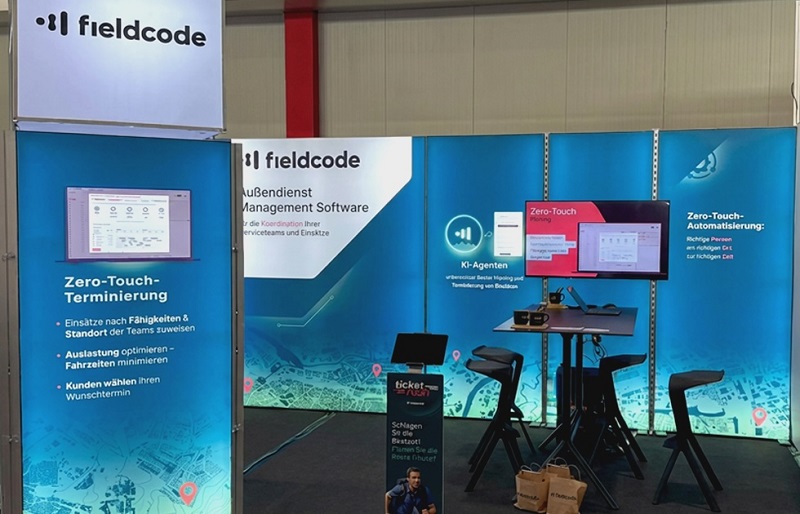
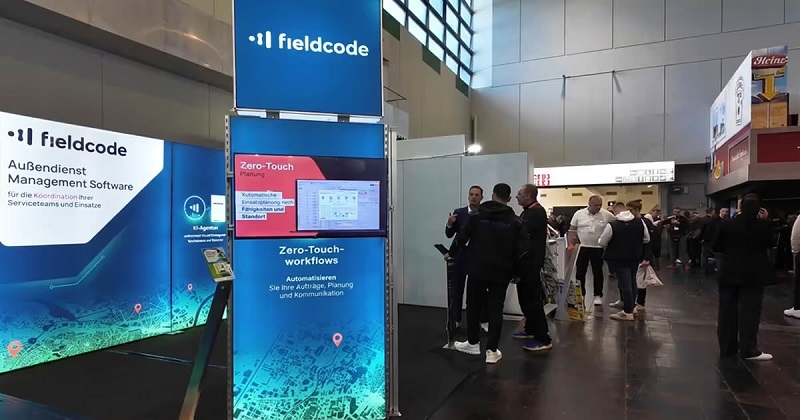
A recurring discussion focused on Zero-Touch automation beginning as early as incident capture and qualification. When that first contact is structured and verified, downstream planning becomes more controlled and predictable. Fieldcode demonstrated automated intake supported by voice AI agents to eliminate manual bottlenecks.
Why these shifts matter operationally
Taken together, the themes from maintenance Dortmund 2026 signal an industry moving toward execution maturity. Tools that simply collect data or produce reports no longer differentiate maintenance outcomes. Instead, success hinges on how consistently detection, decision logic, prioritisation, and dispatch are connected in everyday workflows – reducing manual handling and variability in operations.