
Simplifying complex concepts through accessible modelling and how mobile tools are helping students build real-world intuition faster.
Finite element analysis (FEA) is a powerful tool at the heart of structural engineering, but it remains one of the more abstract and challenging topics for students to master. While most courses dive into full 3D simulations using complex desktop software, this often leaves learners overwhelmed, unsure of what the results truly mean.
What’s missing is often simplicity.
Before jumping into large, multi-part assemblies and dense meshes, engineering students benefit greatly from working with 2D models. Plane stress, plane strain and axisymmetric problems allow students to isolate key behaviours, test assumptions, and directly connect theory with visual results. With fewer variables in play, they can clearly see how loads move through a structure, how constraints affect deformation, and why certain shapes perform better than others.

Using Simpler Tools to Build Deeper Understanding
There’s growing recognition in academia that the path to mastering FEA should start small. Rather than focusing purely on commercial-grade packages, educators are increasingly integrating simplified 2D modelling into their teaching – particularly through tools that make learning more hands-on and immediate.
When choosing an FEA tool for education, there are several features that make a significant difference:
- Rapid iteration – Students should be able to build, modify, and re-solve models quickly to test ideas
- Visual clarity – Clear plots for displacements, stress and strain help students relate outcomes to input assumptions
- Ease of access – No steep learning curve, no licences or setup barriers
- Portability – Tools that can run on common student devices support flexible, on-the-go learning

Quickfem: Bringing FEA to Students, Anywhere
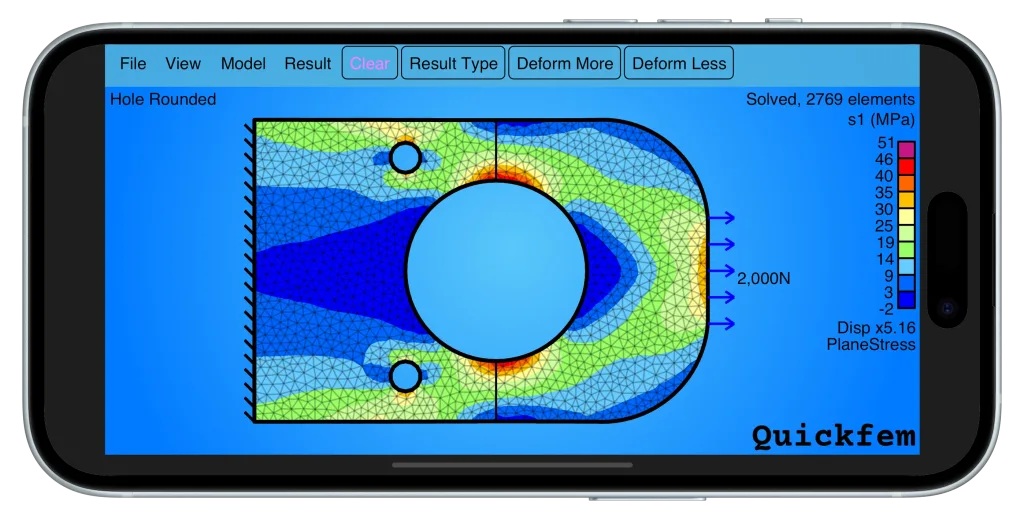
One tool that embodies this approach is Quickfem, a mobile app for iOS and Android that puts 2D FEA in the hands of students and professionals alike. Built for speed and simplicity, it allows users to sketch geometry by touch, apply constraints and loads, and solve structural models in seconds.
Because it runs entirely on-device with no subscriptions or cloud access required, Quickfem makes it easy for students to experiment with structural concepts wherever they are – on campus, in the lab or even during the commute. It supports axisymmetric, plane stress and plane strain models, includes thermal and fastener options, and handles models of up to 100,000 elements depending on device power.
Whether used as part of a course or for independent study, Quickfem helps reinforce what traditional lectures often struggle to deliver: a feel for how structures actually behave.
Quickfem is available now on the App Store and Google Play. Example models and learning resources can be found at https://quickfem.com