
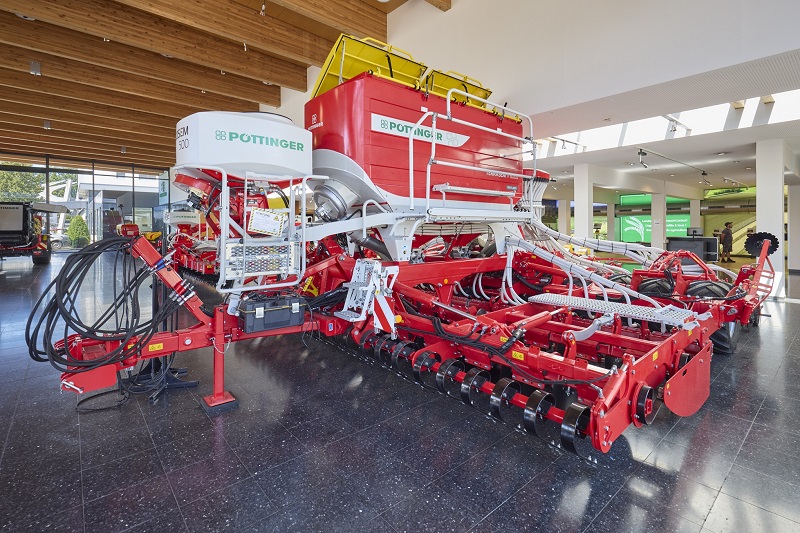
Agricultural machinery manufacturer PÖTTINGER replaced an ageing flexible production system in just twelve weeks. This feat was made possible through a collaborative partnership with machine supplier Starrag and automation specialist PROMOT. The core of the new, highly efficient solution is four Heckert H75 machining centres, which, together with the pallet rack system supplied by PROMOT and a production control station, enable highly flexible, continuously digitalised production.
PÖTTINGER Landtechnik GmbH, Grieskirchen, Austria, manufactures machines and equipment for grassland, farming, and digital agricultural engineering. Whether it is mowing units, loading vehicles, ploughs, cultivators, or assistance systems and software, all products are cutting-edge. Jörg Lechner, Head of Production and Materials Management, says: “As a family-owned company, we attach importance to sustainability, quality, and long-term thinking – values that are directly reflected in our production philosophy.”
This approach is built on highly flexible production as a central principle, with the capability to deliver solutions tailored to customers’ specific requirements. Instead of producing to stock, all products are manufactured on a weekly cycle and can be adapted to market demand. This is clearly evident in the manufacture of plows, where the variety is so vast that there are hardly two identical machines. The PÖTTINGER Engineering Department provides the basis for this customisation with a cleverly designed modular system, which enables the late creation of variants and just-in-time manufacturing despite high complexity.
For almost 20 years, PÖTTINGER has relied on an automated plant with four machining centres and a pallet rack system for mechanical production. For a long time, PÖTTINGER was a pioneer in flexible production. But five years ago, it was time to find a new solution that would once again put the company ahead in production technology.
On the search for a robust, precise, and flexible production system
The range of parts to be produced is extensive: it spans from simple lugs made from structural steel, weighing around 300g, to complex gearbox housings made from cast blanks weighing up to 27kg. Welded frame parts measuring almost 900mm in length also need to be cut on the plant. The required precision is equally challenging. For instance, µm tolerances must be maintained for gearbox housings. Iskender Merkezoglu, Head of Mechanical Production, explains: “This requires both robust and precise machining centres.”
A retrofit of the old plant was quickly ruled out because it would have taken too long. Problems would also arise from differing software versions. Instead, PÖTTINGER opted for a complete exchange during ongoing operations – a ‘Big Bang’.
Machine manufacturer Starrag was awarded the contract for its horizontal machining centres Heckert H75. The machines developed in the Chemnitz factory impressed with their larger working space and collision circle diameter, while maintaining a smaller footprint than comparable machines. “This is an important advantage given our confined spatial conditions. It also looks ahead, as our parts will probably grow in size and complexity,” adds Iskender Merkezoglu. Raimund Hohensinn, responsible for overall production at PÖTTINGER, adds: “The Starrag high-end machining centre is also extremely energy-efficient, which really suits us. At PÖTTINGER, we attach great importance to the economical use of energy.”
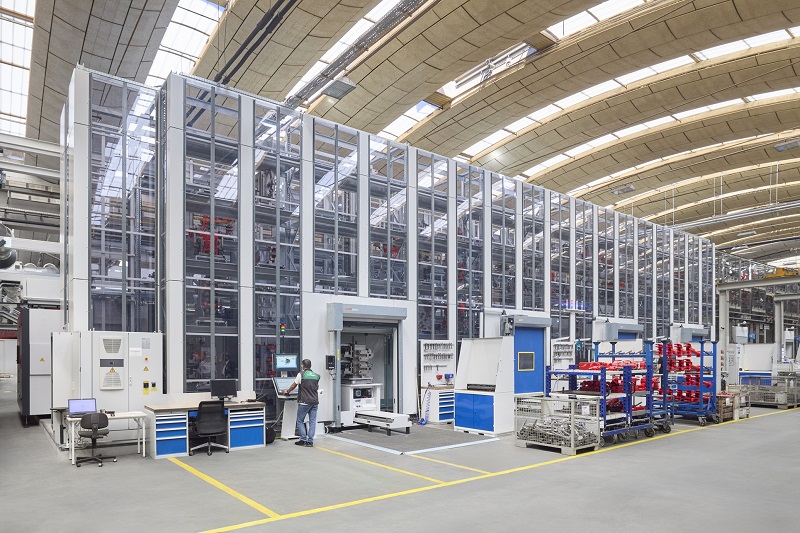
As an automation partner, PÖTTINGER chose PROMOT Automation GmbH, Roitham, which, together with Starrag, offers a decisive advantage: tool management with an optimal price-performance ratio. “For its Heckert H75 machines, Starrag offers an affordable tool magazine with 260 positions,” says Iskender Merkezoglu. “As PROMOT can link the magazines of the four machines via its “Toolmaster” gantry loader, 1040 tools in total are available to us. We can exchange them between the four machines as required.”
This reduces costs and opens up new opportunities in production planning because the production control system can reassign components to a free machine at any time and with minimal effort. Iskender Merkezoglu points out that the tool data on each machine is also available immediately. This is made possible by a Balluff chip, recorded by the presetting device and integrated into the toolholder.
“In the end, the deciding factor for the Starrag/PROMOT solution was the complete package of technology, efficiency, and cooperation,” sums up Production Manager Raimund Hohensinn. “Starrag assisted us greatly during the project phase and provided prompt answers. This built trust. The same applies to PROMOT. As a team, we worked very well from project planning through to commissioning.”
Digital twin and simulation software enable short commissioning and start-up phase
PÖTTINGER assumed coordination and allocated the individual trades directly. The integrator role fell to the automation specialist PROMOT, which integrated the four Heckert H75 units in a high-bay warehouse with 134 slots across five levels, operated by the Palmaster FFS1500 stacker crane. The flexible production system also includes four Vario set-up stations, two of which can be motor-tilted. The plant’s master computer, supplied by PROMOT, communicates with SAP and controls the entire production process.
Mario Hamedinger, responsible for programming and production planning at PÖTTINGER, played a key role on the project team. He recognised early on that the tight twelve-week timeframe for the plant exchange could only be met with digital support. He suggested enlisting the support of Pimpel GmbH, Scharnstein, and their CHECKitB4 software. The software enables NC programmes to be started up on a CAM workstation using a virtual control.
Starrag provided the digital twin of its Heckert H75, which maps the machine and control exactly. As a result, the Pimpel software could simulate the ISO code graphically, check the feasibility of the components, and highlight potential control errors – months before the actual machine installation.
In addition, Starrag supplied the four Heckert H75 to the Chemnitz factory beforehand, allowing programmers and machine setters from PÖTTINGER to test all component machining operations under real conditions well before delivery. “My colleagues and I were in Chemnitz for around four weeks to start up the programs,” reports Mario Hamedinger. “Without the digital twin and CHECKitB4, we would never have been able to meet the twelve-week retrofitting time frame.”
Component cleaning outside the machine results in increased productivity
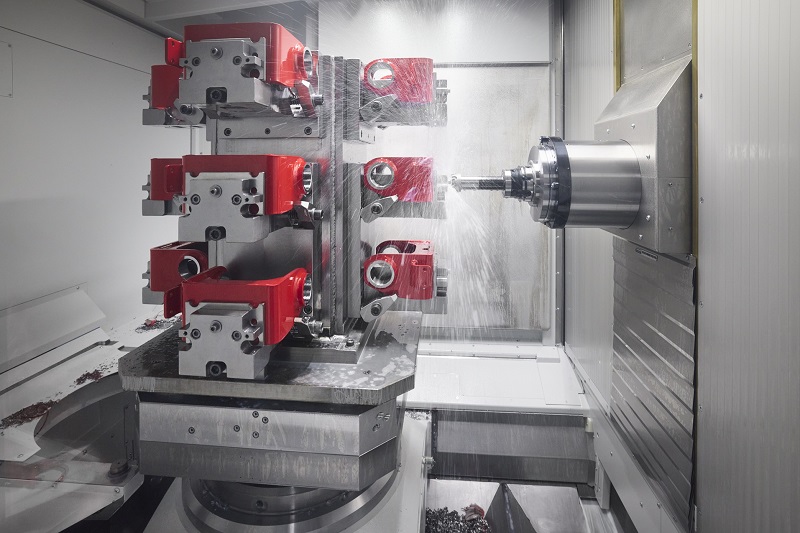
Mario Hamedinger also recognised a need to improve the process chain and realise the associated savings potential. Until now, the flushing of a finished workpiece took place in the machine. “Our aim was to take the flushing step out of the machine,” explains Mario Hamedinger. He was supported by Starrag and PROMOT. They made it possible for the machined workpiece to be transferred to a set-up point in the warehouse via a rotary table. This set-up point has automatically closing gates as well as flushing nozzles for air and cooling liquid. The cleaning takes place there while the machine is already working on the next component. “This saves us at least one minute of production time per pallet change, which equates to almost 20 per cent of the cycle time,” says Mario Hamedinger happily. “An enormous gain in productivity, without having to reduce the milling times.”
PÖTTINGER also modernised the infrastructure during the retrofit. Instead of a decentralised solution, a central coolant supply with a capacity of 8,500 litres is now used. This increases process reliability, reduces maintenance effort, and provides advantages in daily operation.
Iskender Merkezoglu, Head of Mechanical Production, highlights another strength of the Heckert H75 that benefits future operations: “Starrag gives us a so-called fingerprint for these machines, with which we can request all important machine data on site without service technicians. We send the data to the Starrag factory in Chemnitz, where specialists generate a report or analysis for us within one day.” By comparing this data with historical records and test sites, it is possible to determine when vibration values become critical and what measures need to be taken. Such data-based diagnoses enable precise planning of maintenance measures and reduce unplanned standstills.
One single large machine with four machining points
The site acceptance test for the new flexible production system took place after twelve weeks. The start-up in ultimate production mode occurred in a few weeks, thanks to the parallel run-in of the individual machines. During this time, the programmers and machine setters were still fine-tuning the machines. The machining centres must be identical so that the master computer can optimally distribute the orders and make no distinction between machines A, B, C, and D.
To ensure this equality in machine assembly and in the working area, each of the four machines is set up with the same master pallet. As a result, a production system is created that essentially functions as a single large machine with four machining points. This is also taken into account in production planning and control: in the SAP system, each machine does not exist separately, but only one workstation is planned centrally.
 Managing Director Jörg Lechner not only sees the technical achievements as decisive for the success of the project, but also the people behind them. “The success is based on the fact that employees assume responsibility and actively work together on the further development of the processes,” highlights Lechner. “The most important thing for us is that we manage to take people on the journey. Everyone contributes something – and that’s not because it is required, but because they are passionate about it.” In particular, he highlights the partners involved, who acted on an equal footing and with a great deal of mutual trust, as well as the staff at PÖTTINGER, whose commitment contributed significantly to the success of the project.