

MRPeasy analysed 70 case studies to better understand the experiences of small manufacturers with ERP. Case studies span industries including industrial machinery, food, electronics, aerospace, metalworking, and automotive manufacturing, and more.
ERP implementation statistics at a glance
Here are some of the key takeaways from the research:
- 74% of small manufacturers lack operational visibility before switching to ERP.
- 64% rely on spreadsheets before adopting ERP software.
- 82% report improved inventory accuracy after implementation.
- 81% report reduced administrative work.
- The median ERP implementation time for small manufacturers is 2 months.
How we conducted the research
All of the case studies used for our research were based on interviews with MRPeasy customers.
- Sample size: 70 MRPeasy customer case studies.
- Company type: Small manufacturers.
- Company size: Median 15 employees; range 1–200 employees (Employee count known for 55 companies)
Why small manufacturers switch to ERP software
For every small manufacturer, the reason for switching to ERP software depends on different factors.
The most common issue, reported by 74% of small manufacturers, was a lack of visibility into operations. 54% of small manufacturers said they switched to ERP because they outgrew spreadsheets. In addition, 52% said that the administrative burden created by their systems led to ERP adoptions, 37% said multiple disconnected tools proved inefficient, and 35% pointed to lead time issues.
“We needed a better way to handle it,” says Andy Nancollis, Co-founder and Chief Design Officer at Motion Impossible, a camera dolly systems manufacturer from Yate, UK. “The complexity of our new product compared to the older models was overwhelming for a spreadsheet-based system.”
Benefits of ERP implementation for small manufacturers
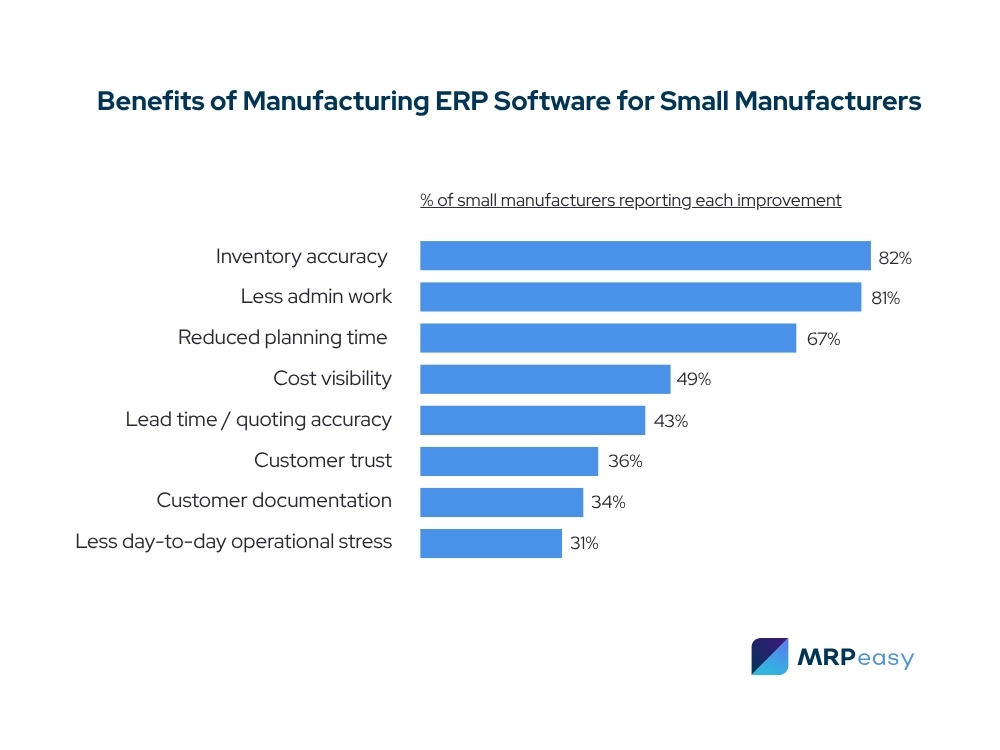
Benefits vary from business to business and depend on factors like company size, industry, and the specific problems they’re trying to solve. Here are the most common benefits of implementing ERP software for small manufacturers:
- 82% of small manufacturers said that ERP software improved inventory accuracy
- 67% said that production planning time was reduced
- 49% noted an improvement in cost visibility
- 43% reported improvements in lead time accuracy and quoting
In many cases, implementing an ERP system also had a noticeable impact on the customer experience. 36% of small manufacturers reported that customer trust increased after implementing an ERP, and 34% noted improvements in customer documentation.
Another benefit of ERP implementation is the reduction in administrative work and day-to-day stress.
- 81% of small manufacturers in our study said ERP software has significantly reduced administrative work
- 31% said ERP software has reduced day-to-day operational stress
“Since we started using MRPeasy, we have achieved over 100% growth in revenue. And we have almost tripled our employee count from 25 to 70 without adding the same proportion of administrative overhead,” says Chris Landen, Managing Director at Exacta Technologies, a computer hardware manufacturer.
How long ERP implementation takes for small manufacturers
ERP software is often associated with long implementation times, with large-scale systems often taking years to implement. Fortunately, software like MRPeasy can significantly reduce implementation time for small manufacturers. Of the 70 customers in our study, 46 of them reported their implementation timelines. Here’s what our research found:
- ERP implementation time ranged from 2 days to 12 months.
- The median implementation time was 2 months.
- Average implementation time was 14 weeks.
Implementation also largely depends on company size. Larger companies typically need more time for process configuration, data migration, and team alignment, and also have more employees to train, and more products, parts, and BOMS to manage. Here are the median ERP implementation times, based on company size:
- 10 or fewer employees: median implementation time of 1 month
- 11–25 employees: 2 months
- 26–50 employees: 3 months
- 51+ employees: 6 months
“I personally think that with concentrated effort, you could sit down and implement MRPeasy within a weekend,” says Lee Brien, Director of Intake Engineering, a precision engineering company from Whitstable.
For more information, please visit mrpeasy.co.uk